
AI for roofing businesses: what should you buy, what should you build, and what has to stay with you?
Three decisions, in that order. Buy software only where the work needs something you can't produce yourself, like aerial measurement or a phone answered at nine at night. Build the drafting layer yourself, because it runs on your own templates and takes an afternoon. Keep the price, the method and the acceptance with a licensed person, because in Queensland an accepted quote is already a binding contract. Most of the AI sold to roofers covers the two ends of a job and leaves the paperwork in the middle exactly where it was.
TL;DR
- What gets pitched as "AI for roofing" is really three separate layers: tools that look at the roof, tools that catch the customer, and the drafting layer that produces your documents. Only the third one runs on material you already own.
- Queensland law sets the boundary, not the software. An accepted quote becomes a legally binding contract, domestic building work priced over $3,300 needs a compliant written contract, and a variation has to be in writing before the variation work starts and within five business days of agreement. 1 2
- Your storm pattern decides the sequence. If enquiries arrive faster than the phone gets answered, that's a purchase. If quotes pile up on your desk after the site visits, that's a workflow you write.
- A monthly subscription, a 90-minute course and a hands-on session are not the same purchase in different sizes. Compare what you keep when you stop paying.
- Pick four numbers before you start. Without a before figure, the only evidence you'll have at renewal time is a feeling.
What is AI actually doing inside roofing businesses right now?
Three different jobs, sold as one category. Separating them is the first thing that makes the decision manageable.
The first layer looks at the roof. Drones fly preset routes, capture imagery, run computer vision to label hail hits, wind uplift or missing shingles, and generate the inspection report automatically. 3 Visualiser products sit in the same layer from the sales side, simulating how different materials and colours would look on the customer's own roof before anything is ordered. 4 This layer needs equipment or a subscription. You can't write your way into it.
The second layer catches the customer. Chat and voice tools answer phones, texts, site chat and social messages, qualify the caller, check technician calendars and book the appointment. 3 The same trade press reports that roofers miss up to 30% of inbound calls during peak season, although that figure travels through US roofing content without a named study behind it, so treat it as a claim about the shape of the problem rather than a measurement of your business. 3
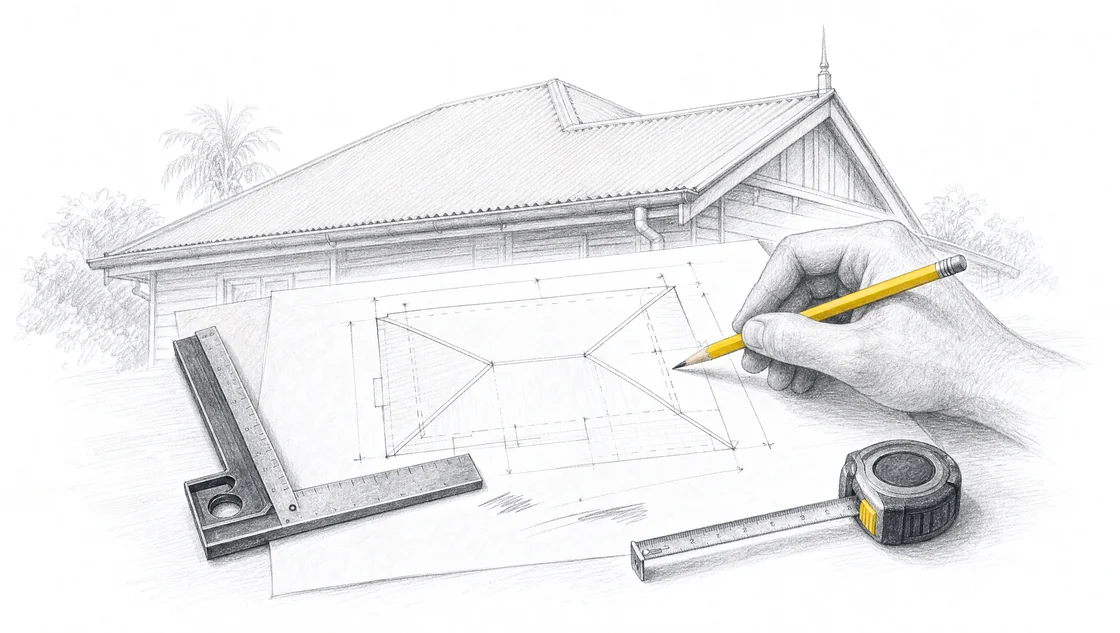
The third layer writes things down. Estimating tools in this layer pull live material prices, your historic labour rates and roof measurements into a line-item quote. 3 So does a general AI assistant, given your notes, your price list and written instructions. That's the difference that matters commercially. The first two layers are purchases. The third is a skill, and a roofing business already owns every input it needs: the site notes, the measurements, the price list, the quote template and the wording you've refined over years of customers reading it.
One line in that trade press deserves more attention than the eleven use cases around it. The Roofing Contractor guide refuses to name a single product, because the author expects the landscape to look completely different by the time anyone reads it. 3 He runs a roofing marketing consultancy, so he isn't a neutral party, and he still won't put a product name in print. Products churn. The method of feeding a machine your own material and checking what comes back does not. If you want the drafting layer written out job by job, I've put the quote, update and follow-up workflows in full on a separate page.
In Queensland, an accepted quote is already a contract, and that fixes where AI stops
This is the part the American roofing content cannot tell you, and it changes the design of the workflow rather than just adding a warning at the end.
The QBCC's position is direct. A quote is a formal statement of what a contractor will charge, and once the customer accepts it, in writing or even verbally, it becomes a legally binding contract. 1 If the job is priced over $3,300 including labour, materials and GST, Queensland law requires a written contract that complies with the QBCC Act, signed and dated by each party. 5 A contractor who doesn't use a compliant written contract commits an offence, and the QBCC can fine, prosecute, apply demerit points or move against the licence. 5
Read that back with an AI drafting workflow in mind. The document your assistant produces is a draft sitting one click away from a binding agreement. So the workflow has to be built with the acceptance step outside it. The AI assembles; a named person with the licence and the commercial authority reviews, prices and sends. That isn't caution for its own sake, it's the legal shape of the transaction.
Variations are where this gets operationally interesting, because the obligation is a documentation deadline and documentation speed is exactly what AI is good at. Before the variation work starts, you must present the variation to the home owner in writing and the owner must agree to it in writing. 2 The written copy has to reach the owner before the earlier of two things: the variation work starting, or five business days from the day both parties agreed. 2 The document itself has to be legible, describe the variation, state the date it was requested, give a reasonable estimate of any delay, state the change to the contract price or the method of calculating it, and say when that increase is payable or the decrease credited. 2 You also can't require payment for a variation before the variation work has started. 2
Six required elements, a five business day clock, and it all begins with a conversation on a roof. That's a drafting problem with a legal deadline attached, which is a much better argument for AI in a roofing business than anything about saving time on emails. Give the assistant the required fields as its output format and the stop rules as its limits, and a scribbled "the battens need replacing on the south side" becomes a structured variation document the same afternoon, with the missing items listed as questions instead of quietly filled in. The five-input prompt method is how you write those limits down so the same instructions run next time.
Nothing here lets the AI decide. Not the repair method, not the price, not whether a variation is reasonable, and not whether the owner has agreed. Those are licensed and commercial judgements, and the documentation obligations sit with the contractor regardless of what drafted the paperwork.
Which end of your business breaks first when the weather turns?
Your storm pattern, not a feature list, should decide what you fix first. Roofing demand is spikier than almost any other trade: one hail cell over a suburb creates a thousand simultaneous customers, all asking the same question within hours, while the other half of the trade is restorations researched slowly and budget first. 6
Two very different businesses hide inside that. Run the diagnosis on last year's numbers.
Count the enquiries that arrived in your busiest week last year and compare that with a normal week. Then count the hours between a site visit finishing and the quote leaving the office, across your last ten jobs. If the first number is where you lose, your bottleneck is intake, and that's a purchase: someone or something answers every call during the day a storm, or the job goes to whoever picked up. If the second number is where you lose, your bottleneck is the desk, and that's a workflow you write yourself, this month, with no vendor involved.
Most owners assume it's the phone because that's the pain you can hear. Check it anyway. A business quoting four days after the inspection is losing jobs quietly, to homeowners who accepted someone else's number on Tuesday. If you want a structured way to pick between candidates, use the task selection guide.
There's a third bottleneck that's easy to miss, and it's whether AI assistants can find you at all when the spike hits. Propeller assessed 516 Australian trade and local service businesses between May and July 2026 and found 69.4% of scored websites rated in their weakest category, with 8.9% of businesses having no findable website whatsoever. 6 Fewer than ten roofers were in that cohort, so there are no roofer-specific figures and the company says so plainly. 6 Take it as a prompt to check that your own coverage, your hours and your make-safe capability are stated on your site in plain text, rather than as a measurement of your trade.
Should you buy software, join a subscription, or train your own team?
Four options, and they're genuinely different purchases rather than the same thing at different prices. This is our own comparison of what a Queensland roofing owner actually gets pitched, and the last row is ours, so read it with that in mind.
| Option | What you get | Published price | What it asks of you | Who it suits |
|---|---|---|---|---|
| Roofing software with AI features | Measurement, damage detection, visualisers, estimating built into a product 3 4 | Per product, usually a recurring licence | Migrating your data and working the way the product works | A business whose constraint is measurement, imagery or an integrated job record |
| Trade AI subscription community | Live build sessions, a growing library of copy-and-paste prompt packs including a quote writing agent trained on five of your real quotes, and a connector that reads your Xero figures 7 | $990 a month including GST, month to month, with a seven day free trial 7 | Showing up repeatedly and doing the implementing yourself | An owner who wants continuous exposure across the whole business, not just one task |
| Short online course | A structured 90 minute run through using ChatGPT and Gemini for roofing and construction tasks, with prompts and templates 8 | Per seat, discounted through industry associations 8 | An hour and a half, and your own translation into your business afterwards | Someone who wants the vocabulary before committing money |
| Hands-on session on your own task | A full day in person building one repeated task from your own notes, price list and template, and you keep the written workflow | A$495 excluding GST per person, maximum 15 paid attendees | Bringing real source material and a laptop | An owner or team who wants to own the drafting layer rather than rent it |
The price column doesn't compare cleanly and shouldn't be read as though it does. A recurring monthly fee and a one-off ticket buy different things over a year, and the honest question is what you still have when you stop paying. A subscription community keeps supplying new material as the tools change, which is a real advantage if you'll use it; the trade academy behind that model publishes a refund on any month that doesn't deliver and lets members keep the packs they've deployed. 7 A four hour session gives you one workflow you wrote and understand, and nothing arrives next month.
I should be clear about where I sit. I previously worked at Radiant Roof Repairs, where we helped automate internal processes with AI, and I left to run Searchmaxxed and Sunshine Coast AI Workshops. That's why this page argues for the drafting layer first rather than for a product: it's the part I've watched work inside a roofing business. If you want that background and the task-by-task version of who checks what, it's set out on my roofing background and the training map that goes with it.
How will you know whether any of it worked?
Write down four numbers before you change anything. Roofing Contractor's own advice is to pick one use case, run a thirty day trial, measure the result and let the numbers guide the next investment. 3 That's right, and almost nobody does it, which is why so many owners can't say whether last year's subscription earned its money.
The four for a roofing business:
- Hours per week the office spends on the chosen task. Estimate honestly; a rough before figure beats no figure.
- Hours between site visit and quote sent, averaged over ten jobs.
- How many drafts come back for rework, and what the rework was. A pattern in the rework tells you which rule you wrote badly.
- What proportion of variations were documented and delivered inside the five business day window. 2
That fourth one is the number a roofing business should care about most and the one no AI vendor will ever put in a dashboard. It's compliance and it's also cash, because a variation you never documented properly is a variation you may struggle to enforce. There's a fuller method for putting a dollar figure on the first two in measuring what an AI workflow actually saves, and a worked example of the quoting workflow itself in this build from site notes to draft quote.
What it takes to get the team using it, not just you
An owner who builds a workflow and tells nobody has bought themselves a hobby. The workflow becomes a business asset when the estimator, the office and whoever answers the phone are all working from the same source material, the same rules and the same review step.
That's what separates the two ways to learn this. Our public workshop on the Sunshine Coast runs a full day in person at Avani Mooloolaba Beach Hotel in The Cove room, A$495 excluding GST per person, capped at 15 paid attendees, with the Wednesday 7 October 2026. Bring a laptop, a charger and one repeated task with a safe example. It suits one person building one workflow, and you leave with instructions you can run again next week.
A roofing business with several people touching the same job usually needs the other thing. When the site notes come from one person, the quote from another and the customer reply from a third, the agreement about what goes in the source material matters more than anyone's prompt writing. That conversation happens best in your own office with your own jobs on the screen. Private onsite training runs at your workplace, is scoped for roughly 4 to 20 people with larger teams split across sessions, and is quoted as a fixed price after we've talked through your team's tasks, location and experience. If that's your situation, the next step is to tell us what your team actually does and get a fixed quote.
Frequently asked questions
Will roofers be replaced by AI?
No, and the shape of the trade is the reason. Nothing in the current toolset climbs a roof, carries materials, holds a licence or accepts liability for a repair method. What AI changes is the paperwork layer around the physical work: the quote, the variation, the update, the follow-up. In Queensland that layer still has a named human on it by law, because the accepted quote is a binding contract and the contractor carries the documentation obligations. 1 2 The competitive risk isn't a machine taking your work, it's the roofer down the road quoting the same job on the same afternoon as the inspection.
Where can I find free AI workshops?
There are genuinely free entry points, and they're the sensible place to start before you spend. Trade training providers run free tiers: the Tradies Success Academy app is free for verified ABN holders in Australia and New Zealand, and its AI subscription carries a seven day free trial. 7 Industry courses are often discounted heavily through associations, such as the roofing and construction AI course offered at 75% off through RoofersCoffeeShop's member program. 8 What free material generally won't do is sit with you while you build a workflow around your own price list and watch where it breaks. That's the difference you're paying for in a paid session, and it's a fair question to ask of any provider before you book.
Does an AI-drafted quote still need a written contract in Queensland?
Yes, and the drafting tool changes nothing about the requirement. Domestic building work priced over $3,300 including labour, materials and GST requires a written contract that is signed and dated by each party and complies with Schedule 1B of the QBCC Act. 5 The QBCC publishes free compliant contract templates, with a level 1 contract for work priced $3,301 to $19,999 and a level 2 for $20,000 and over, and the signed contract has to reach the owner within five business days of entering it. 5 An AI draft is an input to that process, not a substitute for it.
Should we let an AI voice agent talk to homeowners?
For inbound, it's a reasonable answer to a real problem, since the tools answer calls, capture details, check calendars and book inspections when nobody in your office can pick up. 3 For outbound, be careful. The same trade guide warns that homeowners dislike robo-callers and that using AI for outbound calling can damage your reputation. 3 A storm week is exactly when your name is being passed between neighbours, so the downside is concentrated in the same moment as the upside.
Do we need job management software before we start?
No. The drafting layer runs on documents you already have: site notes, measurements, a price list, a quote template and your standard inclusions and exclusions. Job management software helps because those inputs end up in one place instead of four, and integration work is a separate purchase from learning the method. Start with the method, then you'll know what you actually need the software to do.
What should a roofing owner bring to a session?
The laptop you'll use afterwards, its charger, and one repeated task with a safe example: a real job with the customer's personal, account and payment details removed. Bring the price list and the template you already send, because the workflow is built around your own format rather than a generic one. Tool and account requirements are confirmed during scoping for private sessions.
Is this only for roofing businesses on the Sunshine Coast?
No. The public workshop runs in person on the Sunshine Coast and people travel to it. Private onsite training runs at your own workplace across the Sunshine Coast, Brisbane, Gold Coast, Ipswich, Moreton Bay, Logan, Redlands, Toowoomba and Gympie. The same field-to-office problem turns up in every trade that quotes from a site visit, and there's a version of this decision for each of the industries we work with.
Sources
- Unpacking quotes, contracts and variationshttps://www.qbcc.qld.gov.au/news/unpacking-quotes-contracts-variations
- Contract changes and variationshttps://www.qbcc.qld.gov.au/running-your-business/contracts/contract-changes-variations
- 11 Ways to Use AI In Your Roofing Businesshttps://www.roofingcontractor.com/articles/101443-11-ways-to-use-ai-in-your-roofing-business
- Harnessing the Power of Roofing AI: iRoofing's Advanced Roof Visualizerhttps://iroofing.org/roofing-ai/
- Domestic building contractshttps://www.qbcc.qld.gov.au/running-your-business/contracts/domestic-building-contracts
- AI search and websites for roofers in Australiahttps://propeller.net.au/guides/ai-search-websites-for-roofers/
- AI for Roofers / AI Clubhttps://tradies-success-academy.com/ai-for-roofing/
- AI for Roofing & Construction: From Curious to Confident in 90 Minuteshttps://www.rooferscoffeeshop.com/r-club-perk/ai-for-roofing--construction-from-curious-to-confident-in-90-minutes