

AI training for an accounting or bookkeeping practice: which kind fits, and what it has to cover
Two kinds of training are on sale and they answer different questions. The professional bodies teach what AI is, where the ethics sit and how many CPD hours you earned. A hands-on workshop builds one workflow for one job your practice repeats, and you leave with it written down. If information requests, client replies and file notes are eating your week, take the second kind. Whichever you choose, it has to settle which tasks AI may draft, what source material it draws on, who checks the output, and what never leaves your own systems.
Not one of those is a question about which model you use.
TL;DR
- The market splits three ways: professional-body courses that give you CPD hours and the ethical framework, vendor tools that work inside the ledger, and training that builds a workflow for one of your own jobs. They are not substitutes for each other.
- Categorising, matching and chasing a receipt inside the file is a software decision you make once. The writing layer, meaning information requests, client replies, file notes and onboarding, is a skill decision, and nobody sells it to you because it runs on your wording and your standards.
- The first task to bring is the client information request. It repeats, it ends in writing, its source material is sitting in last year's file, and you can check the draft in five minutes.
- BAS work and anything advice-grade is the wrong first task. Software can prepare a draft, and the result still has to be authorised by a person who carries the registration, so write the instruction to keep the draft on the preparation side of that line.
- Put the boundary in the Rules input rather than only in your review at the end. Flag what is missing, never infer a treatment, never state a position the source material does not contain.
- Train on a made-up client or a redacted file. You are building instructions. The client data stays where your practice already keeps it.
- Our public workshop runs a full day in person at Avani Mooloolaba Beach Hotel, in The Cove room, at A$495 excluding GST per person, capped at 15 paid attendees, with the Wednesday 7 October 2026. There are no CPD hours and no certificate. What you leave with is the written workflow and the example you tested.
Which jobs in a practice is AI actually drafting?
The written ones, and there are more of them than most practice owners count.
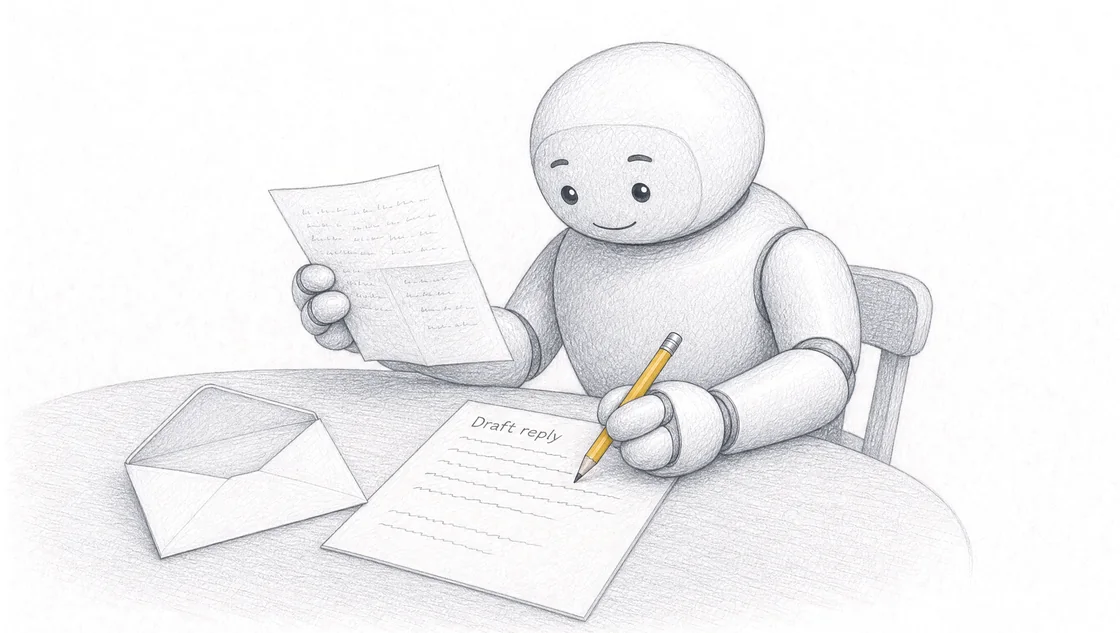
Follow a single business client through a year. They sign, and somebody assembles the onboarding pack and the list of what you need from them. The information request goes out. Four of the eleven items come back, so a second request goes out, politely, about the other seven. The client replies with a question, and the reply has to be accurate and has to sound like your firm. Somebody writes the file note that records what you decided and what you relied on when you decided it. The quarter turns and the same three questions go to forty clients at once. Year-end arrives and a pack has to be explained to somebody who does not read financial statements for a living.
Every one of those produces text, and every one of them draws on facts that are already written down somewhere else: last year's checklist, the engagement scope, the ledger, an email from March.
Now separate two layers, because they are bought differently.
Inside the ledger, the work is already being automated by the platforms. Xero describes AI-assisted bank reconciliation that learns from your past matching decisions, automated data capture through Hubdoc, analytics that flag anomalies, and JAX handling routine tasks such as creating and sending invoices. 1 Document chasing has been productised too. One AI bookkeeping product looks for a matching invoice or bill inside QuickBooks Online, matches it where it finds one, and requests the document automatically where it does not, against thresholds the firm sets. 2 None of that needs a workshop. It needs a decision, a subscription and an afternoon of configuration.
Outside the ledger sits the layer nobody can sell you off the shelf. The wording of your information request. The reply that answers the client's actual question without committing you to something. The file note that will make sense to a reviewer in eighteen months. Those depend on your firm's language, your scope and the standard you hold work to, which means the instruction has to be written by someone inside the practice. Xero's own list puts drafting client emails, summary reports and proposals in the generative AI column, particularly when communication volume spikes in a busy period. 1 That is the layer training is for.
So the honest answer to "how can I use AI in my practice" comes in two parts. You buy the ledger layer from a vendor and spend an afternoon configuring it. You learn the writing layer, because it runs on wording only your practice has.
The first task to bring is the one whose facts already exist
Pick a job that passes four tests.
It repeats, weekly or at least every cycle, in roughly the same shape, so instructions you write once get used again.
It ends in writing. Something whose output is a number, a position or a lodgement needs a different kind of care, and I would come back to it once the first workflow is running.
Its source material exists somewhere you can point at. Last year's checklist, the engagement letter, the standing list of what this client type has to provide, the three requests you were happy with. Where the information only lives in one partner's head, the draft will fill the gap with something plausible, and you will spend longer correcting it than writing it.
You can check the output in about five minutes. A request letter you can read against your own checklist qualifies. A reviewed workpaper file does not.
The client information request passes all four comfortably, which is why I would start there. The information request workflow has everything a first attempt needs: a repeating shape, a client type, a checklist that already exists, and an output you can scan against that checklist before it goes anywhere. The second-request chaser passes too, and it is the one most practices write badly at eleven at night in compliance season. So does the plain-language explanation that goes on top of a year-end pack, as long as the numbers in it are copied from the statements rather than produced by the assistant.
What fails the tests is more interesting.
A BAS fails the third and fourth tests at once. The figures live in the ledger, where software already aggregates them, and the check is not a five-minute read. An advice letter on how something should be structured fails on the first test, because the interesting ones never repeat in the same shape, and it fails on a larger point covered in the next section. A full workpaper review fails the five-minute test. Onboarding is a maybe: the pack and the request are good candidates, and the engagement letter is one I would only automate around a template your practice already stands behind.
If you are choosing between two tasks and cannot separate them, work through the task selection questions and settle it before the session. The task you bring decides what you walk out with.
How do five inputs turn an information request into a draft you can check?
By writing down the five things a competent junior would need before you would let them draft it for you.
The method we teach is five inputs: Context, Task, Source, Rules and Output. The full method is written up here. Applied to an information request, it looks like this.
Context describes the practice, the client and where you are up to. A family trading company on a quarterly cycle, first year with you, works from their phone, responds to short lists and ignores long ones.
Task names the job in one line. Draft the information request for the year-end job for this client.
Source supplies what the job runs on. Last year's checklist, the engagement scope, the current list of outstanding items, the software the client uses, and your standard wording for deadlines and how to send things securely.
Rules set the limits. Use only the facts in the source. Do not calculate, estimate or restate figures. Do not state a treatment, a position or a view about an outcome. Where something is not in the source, list it at the top as a question for me instead of writing around it. Keep the practice's standard wording for scope and deadlines exactly as supplied.
Output describes the finished shape. An itemised request, grouped by where the client has to go to get each thing, in plain language, with a flagged section at the top addressed to me rather than to the client.
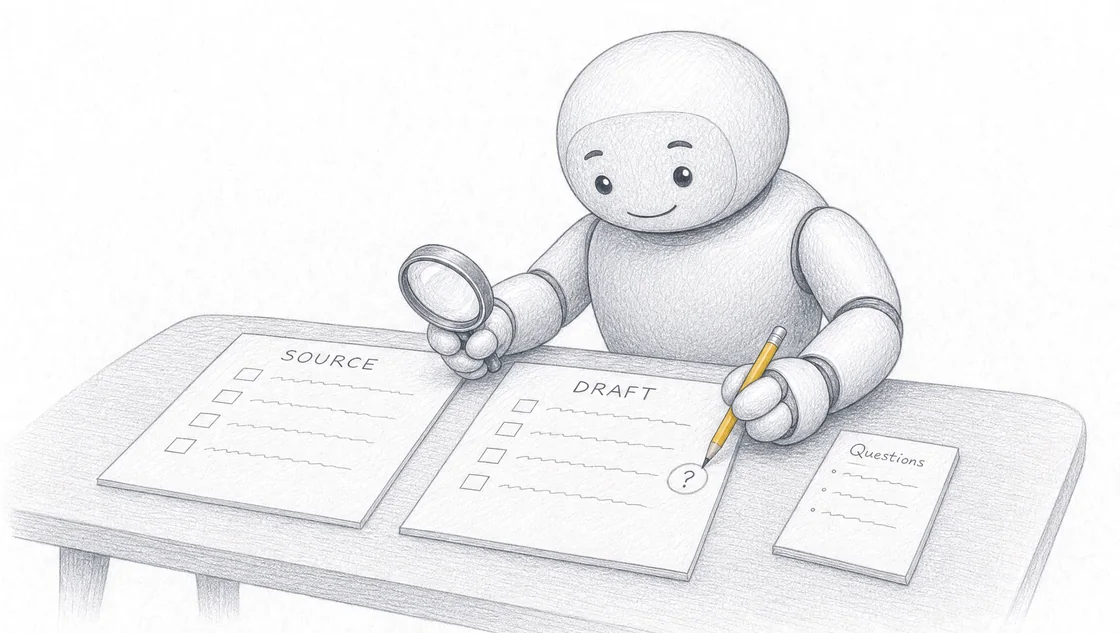
That flagged section is the part I would not trade away. A missing fact you can see is a two-minute fix. A missing fact smoothed into a confident sentence is the one that turns up in a review.
Then you check it. Compare every name, date, figure and commitment against the source you supplied, confirm the draft answers the request you actually made, and read it once as the client will read it. Checking AI output is a repeatable step with a sequence to it, and the point of a tested workflow is that the check gets shorter every time you improve the instruction instead of the draft.
Write the professional boundary into the instruction
Put it in the instruction as well as your review at the end, because the instruction is what stops you catching the same error forty times.
Start with what the profession already says. CPA Australia's guidance is that generative AI belongs in first drafts and idea generation rather than final outputs, and that you remain responsible for reviewing, editing and ensuring any communication is accurate, appropriate and aligned with professional standards. 3 On technical questions it goes further: do not treat generative AI as an authoritative source on accounting standards, laws or regulatory requirements, and always confirm information with primary sources. 3 The technology-related revisions to APES 110 make the allocation of responsibility explicit, with responsibility for professional judgements and outputs remaining with the accountant rather than the technology, alongside the expectation that members maintain the relevant technology skills, critically assess AI-generated information and protect confidential information. 3
The regulator has now put the line in writing. In TPB(GS) 55/2026 the Tax Practitioners Board states that tax practitioners remain ultimately responsible for the tax agent services they provide, and that AI outputs must be assessed and supplemented by professional judgement before being relied on. 4 It goes further on competency: practitioners must exercise their own professional judgement when advising clients and should not rely on AI output as a substitute for their own analysis of a client's circumstances, and because models can hallucinate, they should verify and review AI generated content for accuracy throughout each step of the workflow, documenting each of those steps. 4 Even the vendors selling autonomous bookkeeping say it out loud. One Australian product page states that human review remains non-negotiable, that registered BAS agents retain responsibility for lodgements submitted to the ATO, and that final lodgements must be confirmed by the registered tax or BAS agent. 5 When the most aggressive seller in the category draws the same line as the regulator, treat it as the floor rather than the ceiling.
All of that is a design instruction, and it has three practical consequences.
The first is the one from the Rules input. An assistant that is told not to state a position will tell you it cannot, which is the behaviour you want. An assistant with no such instruction will produce a fluent sentence about treatment because fluent sentences are what it produces.
The second is where the workflow stops. AI prepares, a qualified person authorises. That ordering decides the design, and it means the output of every client-facing workflow arrives at a person before it arrives at a client.
The third is transparency. CPA Australia's position is that where generative AI has materially influenced analysis, wording or conclusions, you should be prepared to explain how it was used, what checks were performed and how compliance was maintained. 3 The cheapest way I know to be ready for that conversation is a line in the file note saying which parts were drafted, what source material the draft was given, and what you checked. It costs about fifteen seconds and it turns a question you would have to reconstruct into a record you already have.
Quality control is also the challenge the platform vendors name themselves. Xero's own list of adoption challenges includes regulatory guidance still developing at bodies including the TPB, and quality control where a human eye remains critical on anything from a draft client letter to an automated reconciliation suggestion. 1 Bentleys, an accounting network, puts the same point more briefly, naming data privacy, bias and the need for human oversight as the main risks to manage. 6
What do you do about client confidentiality in a training session?
You bring a made-up client, or a real one with the identifying detail taken out. We are building the instruction. Your client data stays where it already lives.
A safe example for a practice is easier to construct than people expect, because the workflow does not care whether the numbers are real. It cares about the shape of the job. Invent an entity with a plausible structure and a plausible mess: three of the eleven items provided, a director who answers on WhatsApp, a set of records in one platform and receipts in a shoebox. Or take a real file and strip the name, the ABN, any tax file number, the addresses and the actual figures, and replace them with stand-ins. Preparing safe training data takes about twenty minutes and it is the difference between a session you can run today and a session that waits on a governance decision.
Confidential client information stays inside your practice's own tools and access controls. Which tools those are is your call, and you make it before any session. Before a platform touches client data, the questions to settle are where data is stored and processed, whether it is used to train AI models, what happens to it after an account is closed, and who can access it. 7 Residency varies by vendor and should be confirmed rather than assumed: MYOB stores cloud data in Amazon Web Services Sydney region data centres, while Xero says its hosting locations include Australia, New Zealand and the United States. 7
The exposure that actually bites is smaller and closer to home. Client data ends up in unapproved tools through free personal accounts that nobody registered. 7 The fix there is a rule your people can follow, so a written AI use policy for the team settles it better than a corridor conversation does. Write it before you train anyone to be faster at using these tools.
CPA Australia frames the governance expectation in proportional terms, with the level of oversight reflecting the nature of the activity, the sensitivity of the information and the consequences of an inaccurate or inappropriate output, and with the people using AI needing the knowledge to understand its limitations and evaluate what it produces. 3 Read that as a licence to start small. An information request built on a fabricated client sits at the low end of every one of those dials.
Which kind of training fits your practice?
It depends whether you need a record of learning or a workflow that runs on Monday.
| Option | What you leave with | Recognition | Where it happens | Cost as published |
|---|---|---|---|---|
| Professional-body self-paced courses | Grounding in responsible use, the ethical framework and tool categories | CPD hours, and micro-credentials on some courses | Online, self-paced | The AI and data courses listed on CPA Australia's AI Hub run from AUD 66.00 to AUD 297.00 including GST, at 1.5 to 6.5 CPD hours each 3 |
| Provider or university short courses | A structured curriculum and a credential | Certificate or microcredential, with CPD points on some | Online or blended, over weeks | CA ANZ lists a Certificate in AI fluency. 8 The University of Sydney's AI fluency sprint for accounting professionals is a microcredential listed at A$1,395 including GST, over 2.5 weeks, carrying 30 CPD points 9 |
| Vendor product training | Configuration and confident use of the platform you have bought | Vendor-specific | Wherever the vendor delivers it | Set by the vendor. Not published as a separate training price on the pages we inspected |
| Our public workshop | One written AI workflow for one of your repeated tasks, tested on a safe example | None | In person, a full day, Avani Mooloolaba Beach Hotel, The Cove room | A$495 excluding GST per person |
| Our private onsite training | The same for a team, on one agreed set of source material with one review step | None | At your workplace | Fixed quote after scoping |
That is our own selection from the pages we looked at in September 2026, not an independent ranking, and we sell the last two rows. Read it with that in mind.
The rows do different jobs, and most practices should buy two of them. A partner who has not read APES 110 against the technology revisions should do a professional-body course, because that is the material the profession itself has written and it comes with CPD hours you can point to. Someone who is going to become the internal go-to for this can justify a longer credential. Neither of those produces a working information request for your client base, because neither of them has ever seen your checklist.
What our full day produces is narrower and more immediate: one task, its source material, the instruction written down, the draft tested, the instruction fixed where the draft went wrong, and a method you can use on the second task without me. There are no CPD hours attached and no certificate at the end. If the choice is bothering you, the longer comparison of a workshop against an online course sets out who each format suits. The same decision comes up in every industry we work with, and the answer usually turns on whether the reader needs knowledge or an artefact.
Why learn this from me?
Because the work I have done is the same shape as yours, and I will tell you plainly where it is not.
I am not an accountant and I have not run a practice. I do not give tax advice, and the workshop does not either. What I bring is the design of the workflow around a document: what the assistant is allowed to read, what it must refuse to do, where the person goes in the chain, and how you tell whether the output is right. The professional judgement in your drafts stays yours, which is the arrangement your own code requires anyway.
Two pieces of work are directly relevant.
For Glen House Homoeopathy we used AI to automate SEO, enquiries and administration. A small health practice looks nothing like an accounting practice from the outside. The mechanism is the same one you deal with every day. Enquiries arrive in ordinary language, at all hours, missing about half of what you need in order to answer them, and the practice has to send back one consistent answer regardless of who picks it up. The design problem is turning a partial input into a complete, checkable output while making the gaps visible rather than papering over them. Change the nouns and that is your client reply and your second information request.
In my own business, Searchmaxxed, we built AI workflows for creating blog posts, doing SEO and preparing custom proposals. The proposal workflow is the closest thing I have to your client-facing documents. A proposal assembles facts that already exist into the format the reader expects, and it has to be right because somebody acts on it. What made it work was never the writing instruction. It was deciding which source material the workflow was allowed to draw on, and what it had to do when a fact was missing. That decision is the Rules input, and it is the one most people skip.
Two lessons from that work change how I would build your first workflow.
The first is about what you ask for. We have been building a managed search loop at Searchmaxxed that connects the data about our search presence into one process that can recommend what to do next. Getting that working taught me to ask a narrower question at the start: what information would change the next action? A summary of everything answers a different question. In a practice the difference shows up immediately. "Here is a tidy summary of the file" is pleasant to read. "Here is the request, the three things the source did not cover, and the one item where last year's treatment and this year's scope do not line up" changes what you do in the next ten minutes.
The second is about context. I run my own work through an agent that reads my business's own material, prepares the document and hands back the sources it used, and then I either approve it or send it back. It does not publish and it does not send. Open a chat window instead, describe your practice from memory and ask for an information request, and what comes back is generic, because the assistant never had your checklist, your scope or last year's file in front of it. The gap between those two experiences is almost entirely about source material, and it is the gap a workshop closes.
Public workshop or private onsite training?
Take a public seat if you are the person who does the task. Book private onsite training if the task crosses your team.
The public workshop runs a full day, in person, at Avani Mooloolaba Beach Hotel in The Cove room. A seat is A$495 excluding GST per person, places are capped at 15 paid attendees, and the next date is Wednesday 7 October 2026. Bring a laptop, a charger and one repeated task with a safe example. For a practice that means the fabricated or redacted version of one job: one client information request, one reply, one file note. What to bring covers the rest. You leave with the written workflow you built and the example you tested it on. The workshop page has the current details and the registration.
Private onsite training happens at your workplace, on your team's own tasks. There is no list price. After you enquire we talk about the tasks, the location and how much experience the team has, agree the scope, and then you get a fixed quote. Team size, session length and travel set that quote. Sessions are scoped for roughly 4 to 20 people, and a larger team can be split across sessions. Tool and account requirements are confirmed during that scoping conversation, which is also the right moment to tell us which tools your practice has approved and which it has not.
The case for private is consistency, and in a practice it is a strong one. If one person writes a request from scratch, another copies last year's, and what a client receives depends on who had the file open, then the fix is your team agreeing on one set of source material, one instruction and one review step, in the same room, on the same afternoon.
After the workshop, one person owns the task
You leave with one task working. Running it is still your job.
A full day buys a tested workflow for one task and the method for building the next one. After that, somebody in the practice owns it, keeps the checklist and the standard wording current, and reads the output before it goes out. The review step stays permanently. Your registration rests on it, and improving the instruction never removes it.
When a workflow stops getting used, it is almost always one of two reasons: the source material went stale, or nobody owned it. So pick one task, give it one owner, and run it through a full cycle before you add a second. A quarter is a natural test in this profession, because the same workflow meets forty clients instead of one and you find out quickly where the instruction was too vague.
Training and implementation are different purchases. Training teaches your people to build and run the workflow. Implementation means we build and connect it for you, which is a different engagement with a different price and a different result. Settle which of the two you actually want first, because buying the wrong one is the most common way this money gets wasted.
Frequently asked questions
Can I use AI to do my bookkeeping?
Parts of it, and the parts divide cleanly. Transaction categorisation, document matching and bank reconciliation are already handled inside the major platforms, with Xero describing reconciliation that learns from your past matching decisions and data capture that pulls bills and receipts in automatically. 1 That part you buy and configure. What stays constant is who answers for the result. The TPB's guidance is that practitioners remain ultimately responsible for the services they provide and remain accountable for the accuracy of information and advice given to clients. 4 So the accurate version is that AI can do a lot of the processing and the preparation, and a qualified person still owns the output, the authorisation and anything that goes to the ATO.
Can I use ChatGPT for accounting?
For drafting and explaining, yes, with instructions and a review. For calculations, compliance and positions, no. General assistants draft emails, explain a concept in plain language and summarise a long document, and they lack direct access to your accounting data and cannot verify a calculation. 7 The professional guidance points the same way, treating generative AI as a first-draft and idea-generation tool rather than a source of final output, and specifically warning against treating it as authoritative on standards, laws or regulatory requirements. 3 The practical answer is to give it your own approved source material, tell it in the instruction not to state a position or produce a figure, and read every draft against what you supplied.
Is there an AI that helps with accounting?
Several categories of it, and the category matters more than the brand. There are features built into the platform you already pay for, covering reconciliation, data capture, analytics and task automation. 1 There are dedicated products that work inside your ledger, matching transactions to documents and requesting missing paperwork automatically against thresholds you set. 2 There are agent products sold as a subscription that prepare reconciliations and compliance drafts for review, with one Australian vendor listing A$500 excluding GST per month. 5 And there are general assistants, which is where your own document and correspondence workflows live. We do not rank products, and the choice should follow your biggest bottleneck rather than the other way around.
What is the best AI course for accountants?
It depends whether you want CPD hours or a working process, and those are different purchases. For the professional framework with CPD attached, CPA Australia's AI Hub lists self-paced courses covering AI tools, AI ethics and governance, and AI strategy, running from AUD 66.00 to AUD 297.00 including GST at 1.5 to 6 CPD hours each. 3 CA ANZ lists a Certificate in AI fluency. 8 The University of Sydney runs an AI fluency sprint for accounting professionals as a microcredential, listed at A$1,395 including GST over 2.5 weeks, delivered online with live sessions and carrying 30 CPD points. 9 For a workflow that runs on your own client base next week, a hands-on session on one of your own tasks gets you there faster, and ours does not carry CPD hours. Plenty of practices should do one of each.
Will AI replace bookkeepers and accountants?
No, and the more precise question is which parts of the work are under pressure. The processing and the typing are. The judgement is not, because the judgement is what every draft gets checked against. Xero's position is that the role shifts from transactional processing towards advisory work rather than disappearing. 1 The vendor selling autonomous bookkeeping agrees, describing a hybrid model where AI handles the rules-based work and the professional applies judgement, manages the relationship and authorises the lodgement. 5 The practical implication for a small practice is that knowing what a correct answer looks like becomes more valuable, not less, because you will be checking more drafts and writing fewer of them from scratch.
Do your workshops count towards CPD hours?
No. Our public workshop and our private onsite training do not carry CPD hours, a certificate or professional accreditation. What you leave with is the written AI workflow you built and the safe example you tested it on. If you need CPD, the professional bodies publish courses that carry it, with CPA Australia's AI Hub listing hours against each course. 3 Those two things solve different problems and one does not substitute for the other.
How do I keep client information out of AI tools the practice has not approved?
Decide which tools are approved, write it down, and give people a sanctioned option that is good enough to use. The failure mode named in the Australian guidance is client data ending up in unapproved tools through free personal accounts that nobody registered. 7 Before you approve anything, settle where data is stored and processed, whether it trains the vendor's models, what happens to it after the account closes and who can access it, and confirm residency rather than assuming it. 7 Then make the rule specific to the work: which task types may go near an assistant, what has to be redacted first, and who signs off. A policy that only says "be careful" gets ignored by the person under deadline pressure in the last week of the quarter.
Sources
- How AI in accounting is reshaping the way practices workhttps://www.xero.com/au/accountant-bookkeeper-guides/ai-in-accounting/
- AI Bookkeeper Automation for Australian Firmshttps://booke.ai/en-au
- The CPA Australia AI Hubhttps://www.cpaaustralia.com.au/tools-and-resources/ai-hub
- TPB(GS) 55/2026 The use of Artificial Intelligence and the Code of Professional Conducthttps://www.tpb.gov.au/tpbgs-552026-use-artificial-intelligence-and-code-professional-conduct
- The Future of Bookkeeping: How AI Employees Can Transform Your Practicehttps://agentive.au/blog/the-future-of-bookkeeping-how-ai-employees-can-transform-your-practice/
- AI-Powered Accounting Solutions: Revolutionizing Financial Automation and Data Analytics for Australian Businesses in 2025https://www.bentleys.com.au/resources/ai-powered-accounting-solutions-revolutionizing-financial-automation-and-data-analytics-for-australian-businesses-in-2025/
- Best AI Tools for Accountants in Australia (2026 Guide)https://aivy.com.au/resources/ai-tools-for-accountants-australia/
- AI Learning - CA ANZ Education Storehttps://store.charteredaccountantsanz.com/ai-learning
- AI fluency sprint for accounting professionals (CPA Australia members)https://short-courses.sydney.edu.au/course/PLUSAIA