
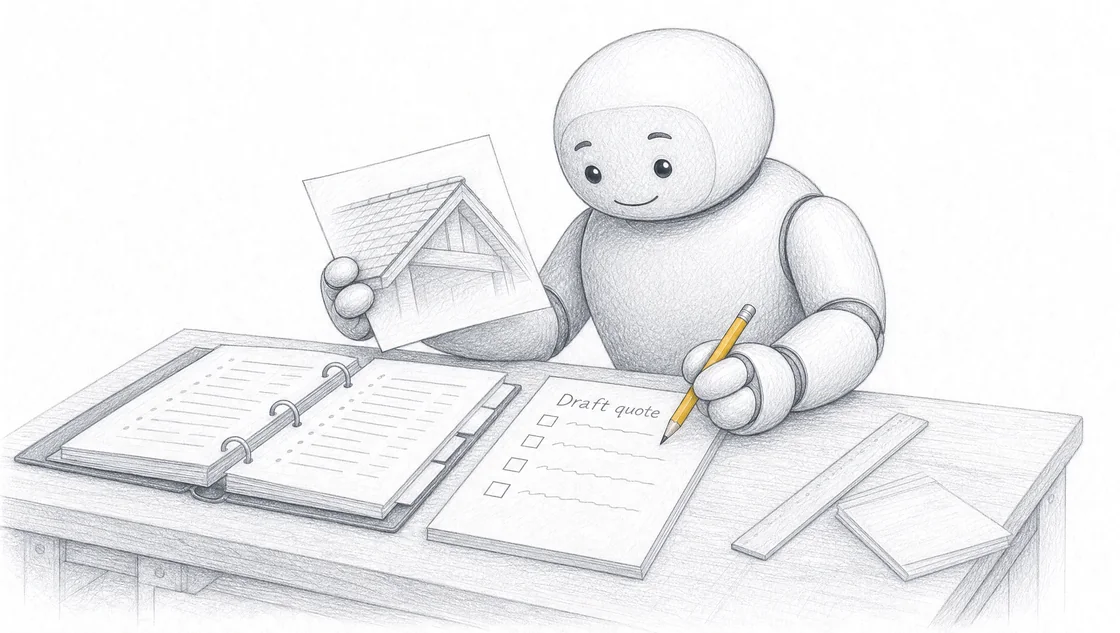
Start with one job the business repeats, and with the place its facts already live. In roofing that's usually the write-up after a site visit, or the follow-up to a customer who's gone quiet on a quote. Both produce text. Both draw on information you already hold, and both get written from scratch every time. I teach this because I've built workflows like it inside operating businesses, including a roofing business I worked in before I left to run Searchmaxxed and Sunshine Coast AI Workshops.
Where those facts live matters more than which model you use.
TL;DR
- Your measurements, rates, photos and site promises sit in four different places, and none of them is the document you have to produce. Picking the model is the easy part.
- Build the first workflow on a job that repeats, ends in writing, has source material you can point at, and produces output you can check in about five minutes.
- Pricing a re-roof fails that test on day one, because the numbers live in an estimator's judgement. Get the rates and exclusions into one sheet first, then automate the writing around them.
- Queensland puts a legal edge on the quoting workflow. An accepted quote becomes a binding contract, domestic building work over $3,300 needs a compliant written contract, and variations go in writing within five business days. AI can draft it; the licensed person still owns every word.
- Write the instructions so the assistant flags what's missing instead of filling the gap. The Rules input exists for exactly that.
- A public seat suits the person who does the task. Private onsite training suits a team where three people write a quote three different ways.
- A full day gives you a tested workflow and the method for the next one. Whether it survives a month depends on one person owning the task and keeping its source material current.
Where does AI actually fit in a roofing business?
It fits at the handovers, where one person's information becomes another person's document.
Follow one job through. Someone rings about a leak over the back bedroom. A person drives out, gets on the roof, takes photos, measures, forms a view about the flashing and the gutter falls, and writes some of it down. Someone prices it. Someone writes the quote. The customer reads it, asks two questions, then goes quiet for a fortnight. Someone chases. The job goes in the diary, the crew finds rotten battens nobody quoted for, a variation gets agreed on the phone, and then it has to be written up properly. At the end there's an invoice, a warranty and a folder of photos nobody opens again.
Every step there is a handover, and at most of them somebody retypes what the last person already knew. The measurements sit in a notebook or a takeoff app. The rates sit in a spreadsheet, or in the estimator's head. What got promised on the roof sits in a text message. The document you actually have to produce sits somewhere else again.
AI is good at producing that document once the facts are in front of it. Getting the facts in front of it is the work. So the first question is which handover costs you the most, and where its information already lives.
The first workflow is the one where the facts already exist
Pick a job that passes four tests.
It repeats. You do it weekly at least, in roughly the same shape, so instructions you write once get used again next week.
It ends in writing. A quote, a scope, a reply, an update, a report. Anything whose output is a decision or a price needs a different kind of care, and I'd come back to it later.
Its source material exists somewhere you can point at. Notes, photos, a rate sheet, the last three quotes you were happy with. If the information only exists in one person's head, the workflow will invent the rest, and you'll spend longer fixing the draft than writing it.
You can check the output in about five minutes. A roofing scope you can read against your own notes qualifies. A month of bookkeeping does not.
Quote follow-ups pass all four comfortably. So does the site-visit write-up, and the weekly update to a customer whose job is running across three weeks and two trades. Pricing a re-roof usually fails the third test, because the rates, allowances and exclusions live in an estimator's judgement rather than in a document anybody else can read. Fix the source first. Once those numbers are written down, the workflow around them becomes straightforward.
The way I teach it, a workflow is five inputs: Context, Task, Source, Rules and Output. Context describes the business and the customer. Task names the job. Source supplies the notes, documents and approved facts. Rules set the limits and say what to flag when something's missing. Output describes the format the finished draft has to arrive in. I've written the method out in full in the five-input prompt.
Rules is the input roofing owners underrate. It's where you tell the assistant that if the flashing detail isn't in your notes, it says so at the top of the draft instead of writing a sentence that sounds right.
Which roofing tasks are worth a workflow?
The published lists are real, and most of what sits on them is sales-side work.
Adam Bensman, who coaches roofing sales teams in the US, runs through eighteen of them: drafting emails and texts to customers, answering after-hours enquiries, recording appointments and turning them into action items, mining review language for the words customers actually use, writing estimates, analysing inbound phone calls, and building an internal assistant over your own SOPs so a new hire can find out how to pull a permit without ringing you. 1 His point about instruction quality is the one I'd keep: AI is a strong tool with clear instruction and a poor one with bad instruction. 1
Estimating has its own tool market. Australian write-ups for builders put AI takeoff subscriptions at roughly A$150 to A$500 a month per seat, and the same guides note that those tools don't check your quantities against the National Construction Code and often default to US material pricing unless you load Australian supplier rates. 2 You can buy the measuring. The judgement about whether the drawing matches the roof stays with the person who's been on it.
Here's the order I'd build in for a roofing business.
First, the site-visit write-up. Photos, measurements and a voice note in, a scope out. The standard to aim at is the one Australian roofing publishers put to homeowners: a scope clear enough that two different roofers would quote the same thing, with removal and disposal, site protection, underlays, flashings and cappings, guttering and clean-up listed one by one. 3 That's a standard an assistant can be held to, because you can read the draft and see whether each line is there.
Second, the quote follow-up and the answers to customer questions. You already have the quote, the questions and the dates. The assistant's job is to write the reply you'd have written on a good day, in your words, with your inclusions.
Third, the weekly job update. Three sentences per active job, pulled from the crew's notes, sent before the customer has to ask. It's the cheapest way I know to stop someone ringing to find out what's happening.
Fourth, the internal answer book. Your own SOPs, warranty terms and supplier details, in a place your team can ask questions of.
What I'd leave until the first four are running: anything that speaks to a customer without a person reading it first, and anything that sets a price.
What Queensland's quote and contract rules change about an AI draft
In Queensland the quote stops being a draft the moment the customer says yes.
Accepting a quote, in writing or even verbally, turns it into a legally binding contract. 4 Domestic building work priced over $3,300 needs a written contract that complies with the QBCC Act, and a contractor who doesn't use a compliant written contract commits an offence that can carry demerit points and consequences for the licence. 5 Variations have their own rules. They go to the customer in writing, with the change in work, any delay and the cost adjustment, within five business days of the agreement or before the work starts, whichever comes first. 4
Put that next to an AI-drafted scope and the workflow design writes itself. The draft is an internal document until a licensed person reads it and sends it. After that it's an instrument with money and a licence attached.
Three rules I'd build into any quoting or variation workflow:
The assistant drafts from your rates, inclusions and exclusions, supplied as source material. It never estimates from what it assumes a roof costs.
Anything it can't source from your material goes in a flagged list at the top of the draft. A missing fact you can see is a two-minute fix. A missing fact smoothed into a confident sentence is the one that turns up in a dispute.
A licensed person reads and sends. The signature is a human act, and the liability follows it.
None of that slows the workflow down. It moves your time from writing to checking, which is where your experience earns its money.
Why learn this with me?
Because I've built these workflows inside businesses that had to keep running while I did it, and one of them was a roofing business.
At Radiant Roof Repairs we helped automate internal processes with AI. I worked there before I left to run Searchmaxxed and Sunshine Coast AI Workshops, so I learned that information chain from the inside, with the phone going.
In my own business, Searchmaxxed, we built AI workflows for creating blog posts, doing SEO and preparing custom proposals. The proposal workflow is the closest thing I have to your quote. A proposal pulls together facts that already exist, arranges them in the format a buyer expects, and has to be right because somebody signs it. The work that made it good was never the writing instruction. It was deciding which source material the workflow was allowed to draw on, and what it had to do when a fact was missing.
For Glen House Homoeopathy we used AI to automate SEO, enquiries and administration. A small health practice looks nothing like a roofing business from the outside. The shape is the same: enquiries arriving in ordinary language, and a practice that needs a consistent answer to go back out.
Two things I've learned change how I'd build your first workflow.
The first is about what you feed it. The managed search loop we've been building at Searchmaxxed connects the data about our search presence into one process that can recommend what to do next. Getting that working taught me to ask a narrower question at the start: what information would change the next action? A summary of every note answers a different question. For a roofing business the difference shows up immediately. "Here's a tidy summary of the site visit" is pleasant to read. "Here's the scope, the three things I couldn't confirm, and the photo you need to look at before this goes out" changes what happens next.
The second is about context. I run my own work through an agent that can read my business's own material. It works from the source files, prepares the document, hands back the sources it used, and I either approve it or send it back. It doesn't publish anything and it doesn't send anything. Open a chat window instead and describe the business from memory, and the draft comes back generic, because the assistant never had your rates, your inclusions or last month's decisions in front of it.
That's what a full day with your own task in front of you is for. Not watching me do it.
Workflow, agent or agentic workflow?
Three terms get used as if they're interchangeable, and the difference decides what you should be buying.
An AI workflow is a repeatable process that uses AI at one or more steps, and a person starts it. A prompt you run over the week's job notes every Friday is an AI workflow.
AI agents for business use tools and take actions towards a goal. An assistant that reads the shared inbox, drafts the reply, checks the diary and books the follow-up is an agent. Before it touches anything a customer sees, its limits need to be written down.
Agentic workflows sit between the two. Agents choose or perform steps inside a process you designed.
Start with the first one. A prompt you run by hand, producing something you'd have written anyway, teaches you the two things the agent version depends on: instructions precise enough to be checked, and source material an assistant can read. Get that working on one task before you hand anything the ability to send.
Public workshop or private training?
Take a public seat if you're the person doing the task. Book private onsite training if the task crosses your team.
The public workshop runs a full day, in person, at Avani Mooloolaba Beach Hotel in The Cove room. A seat is A$495 excluding GST per person, places are capped at 15 paid attendees, and the next date is Wednesday 7 October 2026. Bring a laptop, a charger and one repeated task with a safe example: a quote from a single site visit, a reply to one customer question, a weekly update for one property. You leave with the written workflow you built and the example you tested on it.
Private onsite training happens at your workplace, on your team's own tasks. There's no list price. After you enquire we talk about the tasks, the location and how much experience the team has, agree the scope, and then you get a fixed quote. Team size, session length and travel set that quote. Sessions are scoped for roughly 4 to 20 people, and a larger team can be split across sessions.
The case for private is consistency. If one estimator writes a quote from scratch, another copies the last one, and what a customer receives depends on who picked up the phone, then the fix is your team agreeing on one set of source material, one set of instructions and one review step, in the same room.
Where the training stops and your team's work starts
You leave with a workflow. Running it is still your job.
A full day buys a tested workflow for one task and the method for building the next one. After that, someone in your business owns the task, keeps the rate sheet and the inclusions current, and reads the output before it goes out. When a workflow stops getting used, it's almost always one of two things: the source material went stale, or nobody owned it.
So pick one task, give it one owner, and let it run for a month before you add a second. We also take on implementation, where the system gets built and connected for you. That is a different engagement from training, with its own scope and price. Decide which one you want before you spend anything on either.
Frequently asked questions
How can I use AI for my roofing business?
Pick one job the business repeats that ends in writing, then find where its facts already live. The quote follow-up is the usual starting point, because you already hold the quote, the customer's questions and the dates. Write the instructions as five inputs: Context, Task, Source, Rules and Output. Run it on a safe example, compare the draft against your own notes, and fix the instructions until it comes back right. One task done properly beats a tool subscription you stop opening in March.
Will roofers be replaced by AI?
Nobody is sending an agent up a ladder in a southerly to work out why the flashing leaks. The parts under pressure are written and administrative: quotes, follow-ups, updates, reporting and the answers a new hire needs. Adam Bensman's version, from inside the roofing sales world, is that AI won't take the job, but the people who use it better will take the work. 1 My own read is narrower. The skill that holds its value is knowing what a correct scope and a fair price look like, because that judgement is what every draft gets checked against.
How can I use AI in my construction business?
Same method, longer chain. A builder's information passes through more hands, so the handovers to automate first are usually the reporting ones: site diaries into client updates, variation requests into written notices, supplier quotes into a format you can compare. Keep two checks with a person. Australian estimating guides point out that AI takeoff tools don't verify quantities against the National Construction Code, and that many default to US material pricing unless you load Australian supplier rates. 2 Compliance and price sign-off stay with the licensed person.
Is a full day enough to build a workflow I'll keep using?
For one task, yes, as long as you bring its source material. The full day goes into a single repeated task: writing the instructions, running them on a safe example, finding where the output goes wrong, and fixing the instructions until it comes back right. You keep the written workflow and the example you tested. The task you choose to bring matters more than anything else on the day.
What should I bring to the workshop?
A laptop, a charger and one repeated task with a safe example. Bring the material that task needs: the notes, templates, rates and inclusions you'd normally pull together by hand. If the job runs across several stages, bring the drafting step. You can build instructions for one step without connecting every system you own. For private onsite training, tool and account requirements get confirmed during the scoping conversation.
Sources
- www.youtube.comhttps://www.youtube.com/watch?v=3i6_0Y1CCj8
- flowtivity.aihttps://flowtivity.ai/blog/ai-construction-estimating-takeoffs/
- fortified.com.auhttps://fortified.com.au/qbcc-roofing-contractor-guide-australia/
- www.qbcc.qld.gov.auhttps://www.qbcc.qld.gov.au/news/unpacking-quotes-contracts-variations
- www.qbcc.qld.gov.auhttps://www.qbcc.qld.gov.au/running-your-business/contracts