
I used AI to automate SEO, enquiries and administration for Glen House Homoeopathy. Three things, all of them outside the consulting room. That boundary is the whole point of this article, because a health practice is the clearest case of a business where AI belongs in the front office and nowhere near the clinical decision.
Key takeaways
- Three areas carry the work: search visibility, enquiry handling and practice administration.
- Clinical decisions, treatment advice and patient outcomes stay entirely human. No exceptions.
- Enquiry handling is the fastest win, because the same questions arrive every week.
- The source material is the practice's own approved information, never the model's general knowledge about health.
- The rule that carries everything: flag anything not covered by the approved information instead of answering it.
Where the line sits
| Area | AI role | Human role |
|---|---|---|
| Search and content | Research, structure, draft | Approve every claim |
| New enquiries | Classify, draft a reply from approved information | Read and send |
| Bookings and reminders | Prepare and schedule the message | Confirm the details |
| Records and admin | Summarise and organise supplied information | Check accuracy |
| Health advice | None | Entirely the practitioner |
| Treatment decisions | None | Entirely the practitioner |
| Anything about a specific patient's care | None | Entirely the practitioner |
The bottom three rows are not a caution I added for comfort. They are the design. A workflow that cannot answer a clinical question is a workflow that cannot answer it wrongly.
Enquiry handling
Practices receive the same questions endlessly: what do you treat, what does a consultation cost, how long does it take, do I need to bring anything, where do I park. The answers exist. They are just trapped in the practitioner's head or scattered across old emails.
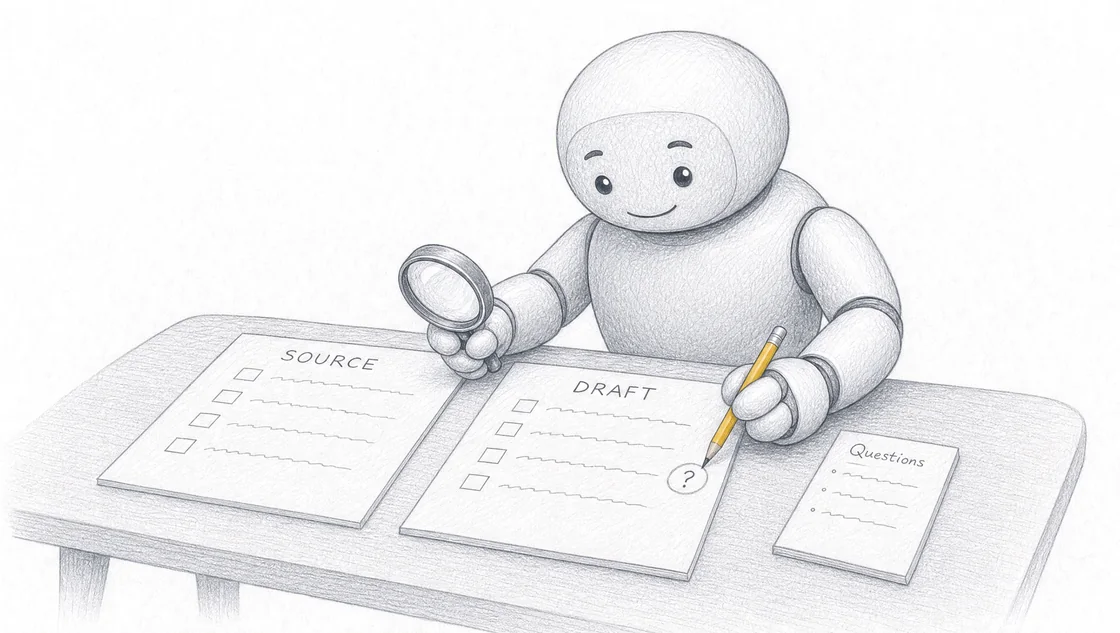
Context. A small health practice, and someone enquiring before they book. Task. Classify the enquiry and draft a reply. Source. The practice's approved answers: services, fees, consultation length, what to bring, location and parking. Rules. Answer only from the approved information. Never give health advice. Never comment on symptoms, conditions or medications. If the enquiry asks something clinical or anything outside the approved set, flag it for the practitioner instead of answering. Output. A short reply, plus a note saying which questions were answered and which were escalated.
A person reads and sends. The workflow removes the blank page, not the judgment.
Search and content
The practice needed to be findable and the content needed to be accurate. The research and structure are mechanical. Every claim about what a practice does, what it costs and what happens in a session comes from the practitioner and gets approved before it goes live.
The rule set here is stricter than for a trade business. No health claims. No outcome claims. No comparative claims about treatments. If the approved material does not support it, the sentence does not exist.
See the natural health page and the non-clinical workflow guide for the detail.
Administration
Appointment-related messages, document requests, records tidying and the small repeated writing tasks that quietly consume a practice day. Same pattern: supplied information in, structured output, human check.
The gain in a solo or small practice is not exotic. It is getting the admin done between patients instead of after dinner.
What this means for any regulated or sensitive business
Three rules travel to every practice, clinic, allied health provider and NDIS service I have looked at.
First, the approved information set is the product. Build it once, keep it current, and the workflows become reliable.
Second, write the escalation rule before the answering rule. The system's most valuable behaviour is refusing to answer.
Third, a person sends anything that reaches a patient or client. Automated sending is a different risk category and there is no reason to accept it for the sake of a few minutes.
Build it for your own practice
A full day at Avani Mooloolaba Beach Hotel, A$495 excluding GST, capped at 15 people. Bring your enquiry inbox and your approved information, with patient detail left out entirely, and you leave with the enquiry workflow built and tested.
Private onsite training runs at your practice across the Sunshine Coast and South East Queensland for roughly 4 to 20 people. Request a team quote, or see the workshop.
Frequently asked questions
What exactly did you automate at Glen House Homoeopathy?
SEO, enquiries and administration. Non-clinical work only. No clinical decision-making, no patient outcomes and no treatment advice were part of it.
Can AI answer patient questions?
It can draft answers to practice questions such as fees, hours, location and what to bring, from information the practitioner has approved. Clinical questions get flagged to a human. That boundary is written into the rules, not left to judgment in the moment.
Is it safe to use AI in a health practice?
In the front office, with approved source material, an escalation rule and a human sending every message, yes. As a source of health information for patients, no. See how to set team rules.
What about patient privacy?
Patient information stays out of general-purpose tools. Build and test with de-identified examples, and keep identifiable records inside your practice systems. How to prepare safe examples.
Does this apply to allied health and medical practices?
The pattern does: front-office only, approved information, escalation rule, human send. The approved information set and the compliance obligations differ by profession. See the allied health page.
What is the first thing to automate in a practice?
The enquiry reply, because the same questions arrive weekly and the answers already exist. Read the enquiry workflow guide.
How do you stop AI giving health advice?
Supply only the approved practice information, and write the rule that says answer from this material alone and flag anything clinical. Then test it by deliberately asking it a clinical question and confirming it escalates.
Do you need clinical software integration?
Not for the drafting layer. Integration with practice management software is separate engineering work and a separate purchase. Compare training with consulting.
Can this handle bookings automatically?
It can prepare and schedule messages. Confirming an appointment detail is a human step, because a wrong time costs a patient a day.
How do you check the output is right?
Compare every drafted answer against the approved information it came from, and keep a list of what got escalated. Here is the checking method.